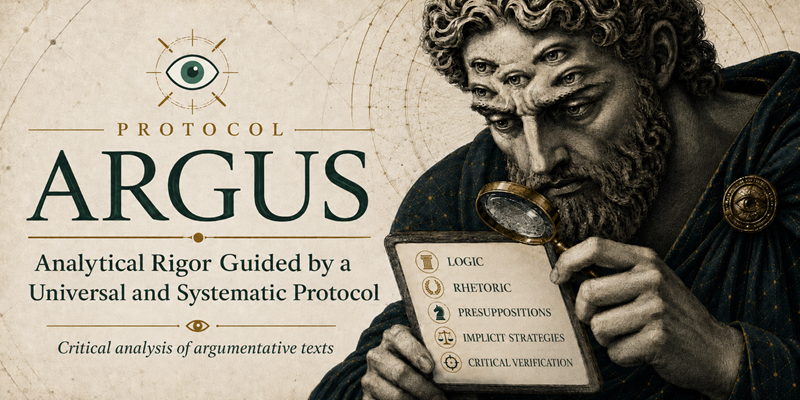
ARGUS — User Guide
What is ARGUS?
ARGUS is an open protocol for the critical analysis of argumentative texts, designed to be used with artificial intelligence. It helps dismantle the mechanics of a text — its logic, rhetoric, presuppositions, and implicit strategies — without being trapped by the persuasive force of the writing.
ARGUS is not tied to any particular model. It can be run by different AIs, provided that the environment has the capabilities needed to read the documents, maintain the protocol instructions, and carry the analysis through to completion.
What does the acronym mean?
ARGUS = Analytical Rigor Guided by a Universal and Systematic protocol.
The name also evokes Argus, the hundred-eyed giant of Greek mythology: a multiple, vigilant gaze that lets nothing escape.
Languages
of the protocol, the analyzed text, and the output
The language of the protocol supplied to the AI, the language of the text being analyzed, and the language of the resulting analysis are independent. Any language version of ARGUS can be used to analyze a text in any language that the AI system can process reliably enough, and the analysis may be requested in a third language.
The published language versions of ARGUS are not variants of the protocol and do not restrict the languages of texts that can be analyzed. Their purpose is to make the method itself readable, understandable, and auditable by as many people as possible. Additional presentation languages may be added if demand warrants it.
An aid and a learning tool
ARGUS serves two functions that cannot really be separated. As an aid, it provides a grid and an order of operations that prevent a step from being forgotten. As a learning tool, it aims at its own partial deactivation: a reader who has conducted around ten full analyses can recognize an opening device, an immunizing concession, or a circularity of sources without needing to run through all eight steps.
The dry run. This leads to a recommended practice, and it is the only part of the protocol that cannot be delegated. Before submitting the text to the AI, answer three questions yourself, in a few lines and without assistance: what presuppositions does the opening of the text install, what is missing, and does the text apply to itself what it demands of others? Then compare your three answers with those in the analysis produced. The differences are where learning takes place. A reader who goes straight to the AI analysis gets a result; a reader who answers first acquires a skill. Ten minutes.
A few terms explained
- Framing (or opening device): the way the text begins — its title, first sentences, first paragraph — imposes a frame that determines what can be said or thought, and what will be excluded from the debate.
- Unproven presupposition: a claim the text treats as true without ever demonstrating it.
- Straw man: an opposing position constructed by the author in a simplified form so that it can be refuted easily.
- Falsifiability: the capacity of a thesis to be contradicted by facts.
- Practical unfalsifiability: a thesis that is refutable in its wording, but for which the text treats every observation as confirmation, including observations pointing in the opposite direction.
- Performative contract: when a text itself prescribes a standard of rigor, that standard is applied back to the text.
- Methodological scope: ARGUS determines the exact object and, for composite texts, the part that genuinely falls under argumentative analysis. Excluded sections remain identified and are examined under the appropriate regime.
- External verification: checking a decisive element against a source actually consulted, whether supplied by the user or sought outside the analyzed object. Knowledge remembered by the model does not constitute external verification.
- Implicit strategic function: what the text does without stating it explicitly.
- Performative contradiction: when the text does the opposite of what it says.
- Recontextualized quotation: an authentic quotation moved into a setting it did not originally concern.
- Displaced rigor: precise references concentrated on claims that are easy to verify, while the claims carrying the thesis remain unsupported.
- Degree of confidence: assessment of the solidity of a hypothesis (high, medium, low).
- Modal retraction: when a text asserts an important proposition as a fact where it serves its demonstration, then weakens it to a mere possibility or leaves it in suspense where standing by it would cost, without acknowledging the change. ARGUS V5.1.0 detects the directional form of this, sparing consistent caution and explicitly acknowledged revision.
How to use ARGUS in
practice
ARGUS can be used in two ways. The ARGUS Skill simplifies installation on compatible platforms; providing the protocol directly remains the universal method. The Skill is an execution layer: it does not replace the protocol. In case of divergence, ARGUS V5.1.0 remains the normative reference.
With the ARGUS Skill
- Download the ARGUS Skill from the dedicated page on this site.
- Install the ZIP file using your platform’s Skill or equivalent management feature. The name and location of this feature may change between services.
- Open a fresh conversation when you want an execution independent of previous analyses.
- Add the text or texts to be analyzed, by pasting or attaching them.
- Give a simple instruction: “Analyze this text with ARGUS.” For several related texts: “Analyze these texts as a corpus with ARGUS.” For a faster analysis: “Use ARGUS Light.”
The same Skill can return the analysis in the requested language. Its technical version is distinct from the version of the protocol it executes.
With the protocol — universal method
- Obtain the protocol ARGUS V5.1.0, available for download on this site.
- Open a fresh conversation with the AI of your choice when you want an execution independent of previous analyses.
- Provide the protocol to the AI: if it accepts attachments, attach the protocol file; otherwise, copy and paste the full text.
- Add the text or texts to be analyzed, by pasting or attaching them.
- Give a simple instruction: “Analyze this text using the ARGUS V5.1.0 protocol.” For several related texts: “Analyze these texts as a corpus using ARGUS V5.1.0.”
- The AI first applies the integrity check and Step 0, then the protocol’s eight steps. In a corpus, Appendix 3 activates before the first individual analysis.
- For a faster analysis, ask: “Use ARGUS Light.” The Light version contains 12 operations and does not apply all the advanced steps of the full protocol.
- Appendix 2 (empty signifiers) activates on request or automatically when the conditions set by the protocol are met.
- Appendix 4 (arithmetical and statistical control) activates automatically when the text contains figures, rates, proportions, counts, or projections that carry evidential weight. You may also request it explicitly.
AI execution requirements
Not all AIs have the same effective execution capabilities. The ability to accept a long prompt or several files is not enough to guarantee that ARGUS can be run in full.
A complete execution requires the environment to combine four capabilities:
- Context capacity: retaining at the same time the protocol, the submitted documents, the user’s instructions, and the intermediate state of the analysis.
- Output capacity: producing a response long enough to complete all activated steps and appendices without an interruption imposed by the interface.
- Document fidelity: reading the supplied files correctly and not confusing an extraction defect, disrupted text order, or an imperfect PDF text layer with genuine truncation of the document.
- Long-horizon constraint retention: respecting the protocol rules through to the end, including scope decisions, appendix activation conditions, verifications, counters, and corpus controls.
At this stage there is no universal threshold expressible as a single number of “tokens.” A context window advertised as very large does not by itself guarantee compliant execution: maximum output length, attachment handling, and stability of instruction following also matter. Limits may also depend on the interface or subscription tier, not only on the underlying model.
An analysis that is interrupted, missing mandatory steps, or continued after part of the context has been lost must not be presented as a complete ARGUS analysis. If the environment cannot run ARGUS in full, use ARGUS Light, reduce the corpus, or change environments. A continuation may be useful for finishing work, but it does not automatically restore the unity of an execution that has lost its earlier state.
Web access and
external verification
Some AIs do not have Web access; others have a search function that must be enabled separately; still others can search recent sources while continuing to rely, in their reasoning, on older internal knowledge.
This matters especially for the external verifications required by ARGUS. An AI must not present as “verified” a fact drawn only from its internal memory. External verification means that it has actually consulted an identifiable and relevant source for the fact being checked, at the date concerned. That source may have been supplied by the user: the absence of Web access therefore does not, by itself, prevent all external verification.
The absence of a search result does not prove that a fact is false. If the AI cannot find a source that confirms or refutes a claim, it must report the check as unsuccessful or the point as unresolved, depending on the case, rather than turning the absence of a result into a refutation.
For facts that may have changed — holder of an office, a recent agreement, an ongoing event, a regulation, updated figures — make sure that the AI has access to contemporary sources, or provide the necessary sources yourself. If that is not possible, the analysis must state the limitation and must not count remembered knowledge as a verification.
Finally, outside verification does not replace reading the text being analyzed: before refuting a claim, the AI must make sure that the text actually makes that claim and in the sense attributed to it.
Reading and
challenging an ARGUS analysis
Reliability of the analysis: the AI is not infallible. Read the analysis critically and check the essentials: integrity of the object, announced steps, mandatory sections, appendices activated when they should have been, consistency of the judgment, and compliance with the absolute rules.
An analysis is not a measurement: two analyses of the same text may diverge, from one AI to another and sometimes from one run to another. That divergence is not corrected by averaging. Points of convergence are relatively robust; divergences identify the places that require the user’s judgment.
Reproducibility: a published analysis records the model used, its version or build, and its reasoning intensity, recorded using the provider’s label verbatim. These indications are part of the conditions for reproduction: they let a reader interpret a divergence between two runs and, in principle, reproduce the analysis under the same conditions. They document a publication practice and do not change the protocol, which aims at an inter-model stability that these very indications make it possible to test.
Challenging the analysis: the short counter-test takes only a few minutes and captures the essentials. In a fresh conversation, without showing the first analysis, ask the same AI to address only Steps 1, 3.E, 3.H, and 7.a, then compare the four results yourself. The protocol describes two more demanding levels: a blind cross-audit by a second AI and documented human adjudication, both suited to analyses intended for publication.
Special cases
Figures, rates, and counts: if the text relies on numerical data, Appendix 4 checks not only where they come from but whether they are possible. A correctly attributed figure may still be arithmetically impossible.
Composite texts: a book or report in which one part argues and another teaches, describes, or documents is not treated as a single block. The AI must declare a scope, name the excluded sections, and state under which regime they are examined.
Several independent texts: when they do not form a connected corpus, it is generally better to analyze them separately and then compare the results.
Corpus of related texts: Appendix 3 — ARGUS-Corpus — organizes the coordinated analysis of several texts. It requires a declaration of the corpus, relevance triage, application of the protocol text by text, a check of intertextual consistency, an examination of circularities, and a synthesis whose scope remains limited to what the corpus can establish.
Primary source attached to an article: an article accompanied by a relevant primary document does not automatically become a corpus. The document may serve as a control source. The primary-source fidelity test activates only when the relationship between the analyzed text and that source is actually established; a mere match of topic, date, or figure is not enough.
Important: ARGUS is designed for argumentative texts or for the argumentative parts of composite texts. It is not intended to treat purely literary, technical, or documentary texts as argumentative.
Last updated: 30 August 2026.